
Hitpoints is your life total and is normally trained indirectly by dealing damage with melee, Ranged, or combat Magic.
COMBAT • F2P + MEMBERS
Hitpoints
A passive skill in the best sense: train damage skills well and Hitpoints follows.
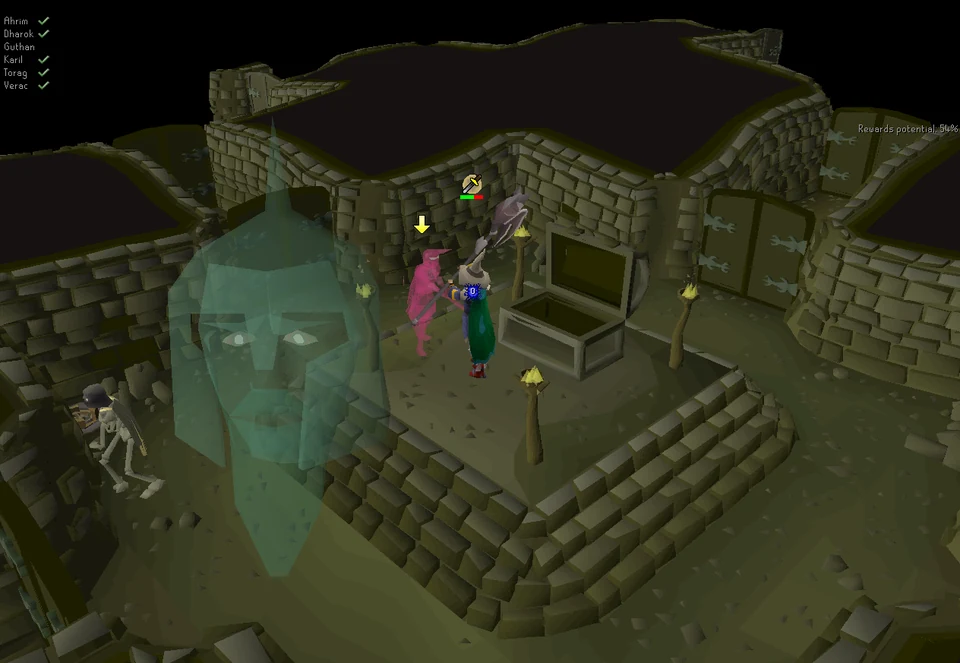
Do not grind Hitpoints by itself unless you have a specialised account-build reason.
Image credits →START HERE
Pick the route that matches your level.
Use the short version below to orient yourself, then set your exact level in the method finder. You do not need to read the whole guide before starting.
01 · LEVEL 10–40Train your main damage styleMelee, Ranged, and most combat spells award Hitpoints XP from damage dealt.Set your level →02 · LEVEL 40–70Quest, Slayer, and safe PvMChoose activities that also unlock travel, gear, and account progression.Set your level →03 · LEVEL 70–90Bossing starts to compoundLonger fights and Slayer tasks provide steady Hitpoints experience.Set your level →04 · LEVEL 90–99Keep doing useful combatRaids, bosses, and high-level Slayer usually finish the skill without a separate grind.Set your level →
UNDERSTANDING HITPOINTS
Learn the system before you optimise the loop.
Hitpoints is a combat skill with several viable routes. The best method is not automatically the one with the largest experience-rate number: startup time, travel, real input prices, useful outputs, and the amount of attention you can sustain all belong in the decision.
This guide treats levels as unlocks rather than a single uninterrupted race to 99. Use the route below as a strong default, then switch when a quest, diary, equipment upgrade, or account goal makes another method more valuable to you.
Most conventional damage awards roughly one-third more Hitpoints XP than damage dealt, while some weapons and activities use special rules.
Food heals to the current maximum unless an item explicitly boosts above it. Better food improves trip length but does not train the skill.
Hitpoints contributes to combat level and changes the damage taken at Wintertodt, which matters to some low-level account routes.
LEVEL-BY-LEVEL METHOD FINDER
Set your level. Get the methods that apply now.
This is the working core of the guide: source-backed training sections filtered by current level and account type, with full rates, quantities, requirements, setup notes, and method tables kept beside their revision.
ACCOUNT
0 Hitpoints sections shown for Members at level 1.
Open a section for its full setup, evidence, and tables.No section matches that filter.
Clear the search or browse every method for this account type.
FOUR EDITORIAL STARTING POINTS
Shortlisted routes with executable instructions.
Use the finder above for the complete method library. These four routes are the fan-guide shortlist: each includes its setup, repeatable sequence, realistic rate band, and most important failure point.
0110–99 • MEDIUM ATTENTION
Normal combat progression
15k–120k HP XP/hr
10–99 • MEDIUM ATTENTION
Normal combat progression
BEST FOR
Nearly every account
ECONOMY
Depends on combat style
LOCATION
Quests, Slayer, bosses, and training areas
REQUIREMENTS
A damage-dealing combat method that awards normal Hitpoints XP
INVENTORY / LOADOUT
The setup for the combat skill being trained
EXECUTION
- Select the combat skill or boss progression the account already needs.
- Maximise sustainable damage rather than trying to optimise Hitpoints in isolation.
- Track deaths and banking time because both erase apparent damage-rate gains.
0220–80 • LOW ATTENTION
Melee or Ranged crabs
8k–45k HP XP/hr
20–80 • LOW ATTENTION
Melee or Ranged crabs
BEST FOR
Low-attention health levels
ECONOMY
Low cost
LOCATION
Sand/ammonite crab areas
REQUIREMENTS
Enough damage to clear spawns
INVENTORY / LOADOUT
Damage gear, potions, food, teleport
EXECUTION
- Use the damage style that also needs levels.
- Choose a spawn count that matches your kill speed.
- Reset aggression and maintain potion boosts.
0370–99 • HIGH ATTENTION
Burst and barrage Slayer
50k–140k HP XP/hr
70–99 • HIGH ATTENTION
Burst and barrage Slayer
BEST FOR
Fast combined Magic/Slayer/Hitpoints
ECONOMY
High rune and prayer cost
LOCATION
Multi-combat task areas
REQUIREMENTS
Ancient Magicks, stackable task, strong rune supply
INVENTORY / LOADOUT
Rune pouch, prayer gear, Magic damage gear, prayer potions
EXECUTION
- Stack assigned monsters on one tile using movement or an alternate account where permitted.
- Maintain protection prayer and multi-target autocast.
- Loot only items whose value exceeds the time and inventory cost.
0475–99 • HIGH ATTENTION
Bossing and raids
20k–100k HP XP/hr
75–99 • HIGH ATTENTION
Bossing and raids
BEST FOR
Finishing levels with useful drops
ECONOMY
Profit after mastery
LOCATION
Account-appropriate bosses and raids
REQUIREMENTS
Mechanics, gear, and death-cost tolerance
INVENTORY / LOADOUT
Encounter-specific switches, supplies, emergency exit
EXECUTION
- Learn mechanics in a setup you can afford to lose or reclaim.
- Record supply cost and deaths over a real sample.
- Increase damage only after the fight is mechanically consistent.
HITPOINTS CALCULATOR
Turn a level goal into hours and materials.
Select a method for its realistic experience-rate band. Add XP and GP per action when you want an exact resource estimate for your chosen item.
The level formula is exact. Time and budget are planning estimates: your equipment, banking, failures, attention, and live Grand Exchange prices determine the real result.
SETUP PROGRESSION
Upgrade the part that actually controls the rate.
| Stage | Setup | Priority |
|---|---|---|
| Early | Best affordable damage gear for the trained style | Damage dealt is the driver of Hitpoints XP. |
| Mid | Task helmet, defender/Ava's device, potions | Multipliers and uptime matter more than tanking trivial targets. |
| Bossing | Encounter-specific defensive switches and strong food | Survival consistency precedes theoretical DPS. |
| Endgame | Raid/boss loadout with minimal unnecessary switches | Every saved inventory slot can become sustain. |
THE ROUTE
From level 1 to cape
1
10–40
Train your main damage style
Melee, Ranged, and most combat spells award Hitpoints XP from damage dealt.Planning note
The opening objective is access, not perfect efficiency. Use quests and inexpensive equipment to compress levels where possible, and avoid over-investing in a method you will outgrow quickly.2
40–70
Quest, Slayer, and safe PvM
Choose activities that also unlock travel, gear, and account progression.Planning note
This is where the skill settles into a repeatable loop. Upgrade the parts of the setup that affect every action, measure a representative session, and keep travel or banking from becoming the hidden bottleneck.3
70–90
Bossing starts to compound
Longer fights and Slayer tasks provide steady Hitpoints experience.Planning note
At the mid-game checkpoint, compare the fastest route with account progress, useful outputs, and attention. A slightly slower method can be more efficient overall when it also supplies quests, diaries, or another skill.4
90–99
Keep doing useful combat
Raids, bosses, and high-level Slayer usually finish the skill without a separate grind.Planning note
Late-game training is a sustainability problem. Recheck prices and unlocks, alternate high-focus sessions with calmer ones, and choose a route you can repeat without turning the cape into a chore.LOWER-INTENSITY ALTERNATIVE
Wintertodt and some nonstandard activities can award small amounts, but combat remains the natural route.
LEVEL REFERENCE
Milestones worth planning around
These are decision points, not instructions to stop. Boostable requirements and quest gates can change when an unlock becomes usable.
| Level | Unlock | Why it matters |
|---|---|---|
| 25 | Early survival buffer | Makes many beginner quests less punishing. |
| 50 | Mid-game baseline | A comfortable pool for basic bosses and Slayer. |
| 70 | Stronger food efficiency | Supports longer PvM encounters. |
| 75 | Imbued heart-style boosting context | A common broader combat checkpoint. |
| 90 | High-level survivability | Useful for raids and dangerous bosses. |
| 99 | Hitpoints cape | Provides a regeneration-oriented perk when worn. |
QUEST ROUTING
Let account progress do part of the grind.
Quest experience is most valuable when it skips slow early methods or opens a training system you will keep using.
Witch's House
A classic early Hitpoints boost; bring a safe plan for the final fights.
Waterfall Quest
Its melee rewards lead to fast early Hitpoints gains when training begins.
Recipe for Disaster
The quest line tests survivability and unlocks some of the game's best general melee gloves.
CHOOSE YOUR ACCOUNT
The route changes with the rules you play by.
Spend for the time you value
Mains rarely need a Hitpoints-only method. Train the combat skill that unlocks your next goal and view Hitpoints as the durable record of damage dealt along the way.
Optimise the whole supply chain
On an iron, higher Hitpoints increases survivability but also food consumption in difficult encounters. Improve food, teleports, and protection prayers alongside the raw level.
Know the edge of the map
Free-to-play accounts train Hitpoints naturally through the three combat styles. Members add Slayer, bosses, minigames, and quest rewards that make progression much less repetitive.
REVISION-PINNED REFERENCE
The detailed tables behind the recommendations.
Pulled in one batch from the Old School RuneScape Wiki on August 2, 2026. Every table keeps its source page and revision so you can verify requirements or spot a later game update.
No stable rate table was available for Hitpoints.
The practical manual above is curated directly; use the linked revision sources below to verify mechanics after updates.
SOURCE PAGES
- Pay-to-play Hitpoints training →revision 14994942
- Hitpoints training →revision 14219412
- Free-to-play Hitpoints training →revision 14013856
- Ironman Guide/Hitpoints →revision 14874924
- Hitpoints →revision 15285022
- Hitpoints/Level up table →revision 15248208
Reference tables are adapted with attribution from the community-maintained OSRS Wiki. Editorial recommendations, method walkthroughs, warnings, and calculators are original fan-guide material.
COMMON QUESTIONS
Hitpoints FAQ
What is the fastest way to train Hitpoints?
High-damage combat methods generate the most Hitpoints XP, but the best choice is usually the combat training or PvM you already need.
Does cannon damage give Hitpoints XP?
Dwarf multicannon damage awards Ranged XP but does not provide the normal Hitpoints experience from damage.
KEEP RESEARCHING
Read the local training reference →Game updates can change rates, requirements, and best methods. Check the community reference before a large purchase.
COMBAT

Attack training
Unlock accurate weapons first, then let Slayer and quests carry the long grind.
Open guide →COMBAT
Strength training
Prioritise max hits: Strength usually gives the biggest early boost to melee damage.
Open guide →COMBAT
Defence training
Train enough for the armour you need, then finish levels alongside Slayer or bossing.
Open guide →COMBAT
Ranged training
Use cheap ammunition for the base, then scale into Slayer, chinning, or bossing.
Open guide →Ready to price the route?